Bio::EnsEMBL::DBSQL::SequenceAdaptor Class Reference
 Inheritance diagram for Bio::EnsEMBL::DBSQL::SequenceAdaptor: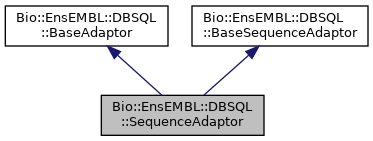
Detailed Description
Synopsis
my $sa = $registry->get_adaptor( 'Human', 'Core', 'Sequence' );
my $dna =
${ $sa->fetch_by_Slice_start_end_strand( $slice, 1, 1000, -1 ) };
Description
An adaptor for the retrieval of DNA sequence from the EnsEMBL database
Definition at line 22 of file SequenceAdaptor.pm.
Member Function Documentation
◆ _fetch_by_Slice_start_end_strand_circular()
| protected Bio::EnsEMBL::DBSQL::SequenceAdaptor::_fetch_by_Slice_start_end_strand_circular | ( | ) |
Undocumented method
Code:
click to view
◆ _fetch_raw_seq()
| protected Bio::EnsEMBL::DBSQL::SequenceAdaptor::_fetch_raw_seq | ( | ) |
Description : Communicates with the database to fetch back sequence
Code:
click to view
◆ _populate_seq_region_edits()
| protected Bio::EnsEMBL::DBSQL::SequenceAdaptor::_populate_seq_region_edits | ( | ) |
Description: Query the database for any _rna_edit attributes attached to a seq region
Code:
click to view
◆ _rna_edit()
| protected Bio::EnsEMBL::DBSQL::SequenceAdaptor::_rna_edit | ( | ) |
  Description : Performs within sequence region editting when
                the underlying sequence is incorrect. Used by LRGs.
Code:
click to view
◆ can_access_Slice()
| public Bio::EnsEMBL::DBSQL::SequenceAdaptor::can_access_Slice | ( | ) |
◆ fetch_by_Slice_start_end_strand()
| public String Bio::EnsEMBL::DBSQL::SequenceAdaptor::fetch_by_Slice_start_end_strand | ( | ) |
  Arg  [1]   : Bio::EnsEMBL::Slice slice
               The slice from which you want the sequence
  Arg  [2]   : (optional) int startBasePair
               The start base pair relative to the start of the slice. Negative
               values or values greater than the length of the slice are fine.
               default = 1
  Arg  [3]   : (optional) int endBasePair
               The end base pair relative to the start of the slice. Negative
               values or values greater than the length of the slice are fine,
               but the end must be greater than or equal to the start
               count from 1
               default = the length of the slice
  Arg  [4]   : (optional) int strand
               1, -1
               default = 1
  Example    :
$dna = $seq_adptr->fetch_by_Slice_start_end_strand($slice, 1,
1000, -1);
  Description: Retrieves from db the sequence for this slice
               uses AssemblyMapper to find the assembly
  Returntype : string
  Exceptions : endBasePair should be less or equal to length of slice
  Caller     : Bio::EnsEMBL::Slice::seq(), Slice::subseq()
  Status     : Stable
Code:
click to view
◆ new()
| public Bio::EnsEMBL::DBSQL::SequenceAdaptor Bio::EnsEMBL::DBSQL::SequenceAdaptor::new | ( | ) |
  Arg [1]    : none
  Example    :
my $sa = $db_adaptor->get_SequenceAdaptor();
  Description: Constructor. Calls superclass constructor and initialises
               internal cache structure.
  Returntype : Bio::EnsEMBL::DBSQL::SequenceAdaptor
  Exceptions : none
  Caller     : DBAdaptor::get_SequenceAdaptor
  Status     : Stable
Code:
click to view
◆ remove()
| public void Bio::EnsEMBL::DBSQL::SequenceAdaptor::remove | ( | ) |
  Arg [1]    : int $seq_region_id the id of the sequence region this dna
               is associated with.
  Example    :
@co
de $seq_adaptor->remove(11);
  Description: removes a dna sequence for a given seq_region_id
  Returntype : none
  Exceptions : throw if the database delete fails
  Caller     : Internal
  Status     : Stable
Code:
click to view
◆ store()
| public void Bio::EnsEMBL::DBSQL::SequenceAdaptor::store | ( | ) |
  Arg [1]    : int $seq_region_id the id of the sequence region this dna
               will be associated with.
  Arg [2]    : string $sequence the dna sequence to be stored
               in the database.  Note that the sequence passed in will be
               converted to uppercase.
  Example    :
$seq_adaptor->store(11, 'ACTGGGTACCAAACAAACACAACA');
  Description: stores a dna sequence in the databases dna table and returns the
               database identifier for the new record.
  Returntype : none
  Exceptions : throw if the database insert fails
  Caller     : sequence loading scripts
  Status     : Stable
Code:
click to view
The documentation for this class was generated from the following file:
- ensembl/modules/Bio/EnsEMBL/DBSQL/SequenceAdaptor.pm