Bio::EnsEMBL::DBSQL::BaseAdaptor Class Reference
 Inheritance diagram for Bio::EnsEMBL::DBSQL::BaseAdaptor: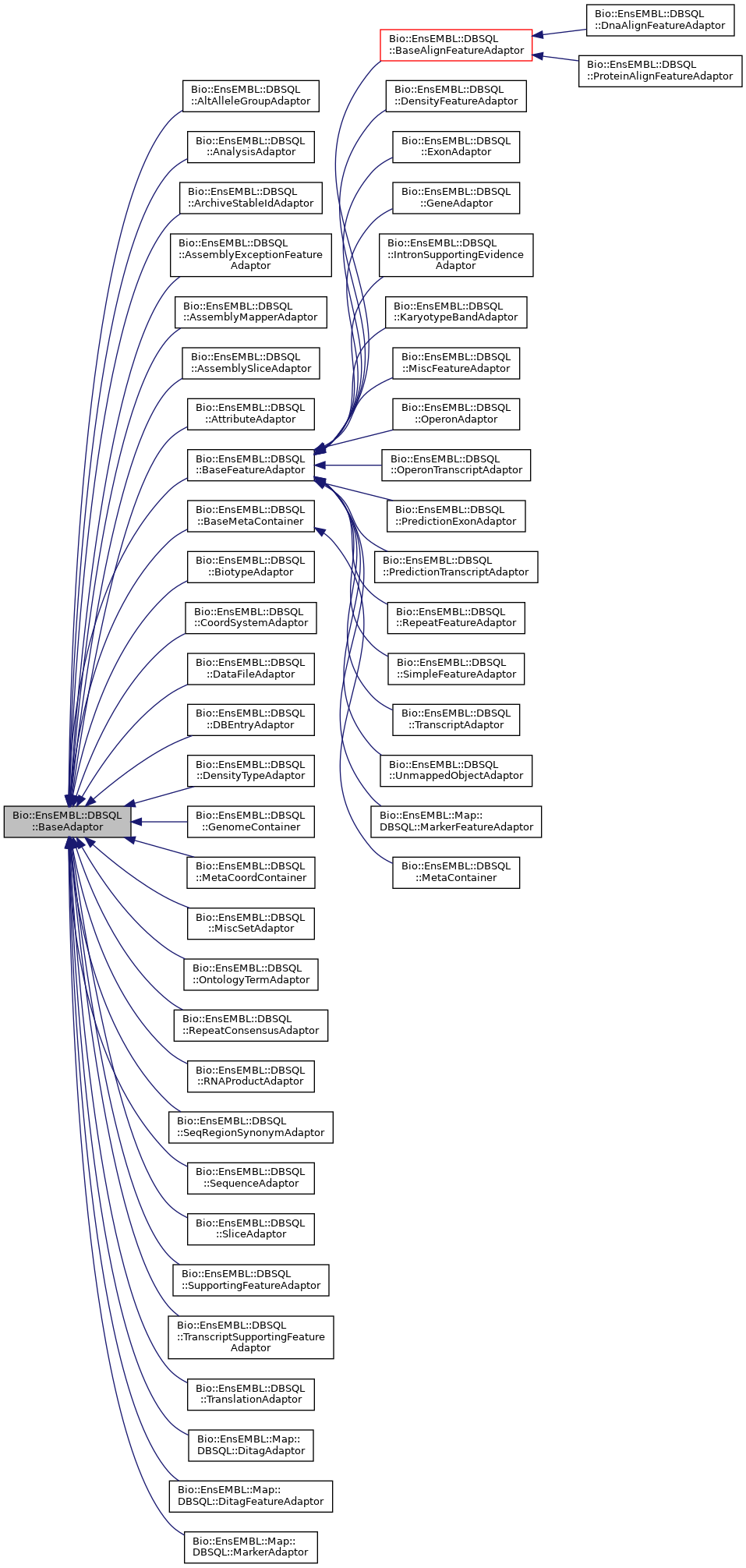
Detailed Description
Synopsis
# base adaptor provides
# SQL prepare function
$adaptor->prepare("sql statement");
# get of root DBAdaptor object
$adaptor->db();
# constructor, ok for inheritence
$adaptor = Bio::EnsEMBL::DBSQL::SubClassOfBaseAdaptor->new($dbobj);
Description
This is a true base class for Adaptors in the Ensembl DBSQL
system.

Adaptors are expected to have the following functions

  $obj = $adaptor->fetch_by_dbID($internal_id);

which builds the object from the primary key of the object. This
function is crucial because it allows adaptors to collaborate relatively
independently of each other - in other words, we can change the schema
under one adaptor without too many knock on changes through the other
adaptors.

Most adaptors will also have

  $dbid = $adaptor->store($obj);

which stores the object. Currently the storing of an object also causes
the objects to set

  $obj->dbID();

correctly and attach the adaptor.

Other fetch functions go by the convention of

  \@object_array = \@{ $adaptor->fetch_all_by_XXXX($arguments_for_XXXX) };

sometimes it returns an array ref denoted by the 'all' in the name of
the method, sometimes an individual object. For example

  $gene = $gene_adaptor->fetch_by_stable_id($stable_id);

or

  \@fp = \@{ $simple_feature_adaptor->fetch_all_by_Slice($slice) };

Occassionally adaptors need to provide access to lists of ids. In this
case the convention is to go list_XXXX, such as

  \@gene_ids = \@{ $gene_adaptor->list_geneIds() };

(note: this method is poorly named)
Definition at line 71 of file BaseAdaptor.pm.
Member Function Documentation
◆ _bind_param_generic_fetch()
| protected Bio::EnsEMBL::DBSQL::BaseAdaptor::_bind_param_generic_fetch | ( | ) |
Undocumented method
Code:
click to view
◆ _build_id_cache()
| protected Bio::EnsEMBL::DBSQL::BaseAdaptor::_build_id_cache | ( | ) |
Undocumented method
Code:
click to view
◆ _can_straight_join()
| protected Bio::EnsEMBL::DBSQL::BaseAdaptor::_can_straight_join | ( | ) |
Undocumented method
Code:
click to view
◆ _columns()
| protected Bio::EnsEMBL::DBSQL::BaseAdaptor::_columns | ( | ) |
Undocumented method
Code:
click to view
◆ _default_where_clause()
| protected Bio::EnsEMBL::DBSQL::BaseAdaptor::_default_where_clause | ( | ) |
Undocumented method
Code:
click to view
◆ _final_clause()
| protected Bio::EnsEMBL::DBSQL::BaseAdaptor::_final_clause | ( | ) |
Undocumented method
Code:
click to view
◆ _generate_sql()
| protected Bio::EnsEMBL::DBSQL::BaseAdaptor::_generate_sql | ( | ) |
Undocumented method
Code:
click to view
◆ _id_cache()
| protected Bio::EnsEMBL::DBSQL::Support::BaseCache Bio::EnsEMBL::DBSQL::BaseAdaptor::_id_cache | ( | ) |
  Description : Used to return an instance of a support BaseCache module
                which can be used to speed up object access. The method
                also respects the DBAdaptor's no_cache() flag and will
                return undef in those situations
  Example     :
my $cache = $self->_id_cache();
Returntype : Bio::EnsEMBL::DBSQL::Support::BaseCache
Code:
click to view
◆ _left_join()
| protected Bio::EnsEMBL::DBSQL::BaseAdaptor::_left_join | ( | ) |
Undocumented method
Code:
click to view
◆ _list_dbIDs()
| protected Bio::EnsEMBL::DBSQL::BaseAdaptor::_list_dbIDs | ( | ) |
Undocumented method
Code:
click to view
◆ _logic_name_to_constraint()
| protected Bio::EnsEMBL::DBSQL::BaseAdaptor::_logic_name_to_constraint | ( | ) |
Undocumented method
Code:
click to view
◆ _no_id_cache()
| protected Boolean Bio::EnsEMBL::DBSQL::BaseAdaptor::_no_id_cache | ( | ) |
  Description : Flags if the ID based caching is active or not. This could be
                due to the adaptor not wanting to cache or because of
                a global no_cache() flag on the DBAdaptor instance
  Returntype  : Boolean
Code:
click to view
◆ _objs_from_sth()
| protected Bio::EnsEMBL::DBSQL::BaseAdaptor::_objs_from_sth | ( | ) |
Undocumented method
Code:
click to view
◆ _straight_join()
| protected Bio::EnsEMBL::DBSQL::BaseAdaptor::_straight_join | ( | ) |
Undocumented method
Code:
click to view
◆ _tables()
| protected Bio::EnsEMBL::DBSQL::BaseAdaptor::_tables | ( | ) |
Undocumented method
Code:
click to view
◆ _uncached_fetch_all_by_dbID_list()
| protected Bio::EnsEMBL::DBSQL::BaseAdaptor::_uncached_fetch_all_by_dbID_list | ( | ) |
Undocumented method
Code:
click to view
◆ _uncached_fetch_all_by_id_list()
| protected ArrayRef Bio::EnsEMBL::DBSQL::BaseAdaptor::_uncached_fetch_all_by_id_list | ( | ) |
  Arg [1]    : listref of IDs
  Arg [2]    : (optional) Bio::EnsEMBL::Slice $slice
               A slice that features should be remapped to
  Arg [3]    : String describing the ID type.
               Valid values include dbID and stable_id. dbID is an alias for
               the primary key, while other names map directly to table columns
               of the Feature this adaptor manages.
  Arg [4]    : Boolean $numeric
               Indicates if the incoming data is to be processed as a numeric
               or as a String. If arg [3] was set to dbID then we default this to
               be true. If arg [3] was set to stable_id then we default this to
               be false.
               When not using a standard arg[3] the IDs are assumed to be Strings.
  Arg [5]    : Integer $max_size
               Control the maximum number of IDs sent to a database in a single
               query. Defaults to 2K for Strings and 16K for integers. Only
               provide if you know *exactly* why you need to edit it.
  Example    :
$list_of_features = $adaptor->_uncached_fetch_all_by_id_list(
[qw(ENSG00000101321 ENSG00000101346 ENSG00000101367)],
undef,
"stable_id", 0); #using strings
@section autotoc_md2 Numeric set to true because we are using numerics
$list_of_features = $adaptor->_uncached_fetch_all_by_id_list(
[1,2,3,4],
undef,
"dbID", 1);
@section autotoc_md3 Numeric defaults to true because we are querying using dbID
$list_of_features = $adaptor->_uncached_fetch_all_by_id_list(
[1,2,3,4],
undef,
"dbID");
  Description: This is a generic method used to fetch lists of features by IDs.
               It avoids caches, meaning it is best suited for block fetching.
               See fetch_all_by_dbID_list() for more info.
  Returntype : ArrayRef of Bio::EnsEMBL::Feature
  Exceptions : Thrown if a list of IDs is not supplied.
  Caller     : BaseFeatureAdaptor, BaseAdaptor and derived classes.
Code:
click to view
◆ _uncached_fetch_by_dbID()
| protected Bio::EnsEMBL::DBSQL::BaseAdaptor::_uncached_fetch_by_dbID | ( | ) |
Undocumented method
Code:
click to view
◆ bind_param_generic_fetch()
| public Listref Bio::EnsEMBL::DBSQL::BaseAdaptor::bind_param_generic_fetch | ( | ) |
 Arg [1]   : (optional)  scalar $param
              This is the parameter to bind
 Arg [2]   : (optional) int $sql_type
              Type of the parameter (from DBI (:sql_types))
 Example   :
$adaptor->bind_param_generic_fetch($stable_id,SQL_VARCHAR);
$adaptor->generic_fetch();
 Description:  When using parameters for the query, will call the bind_param to avoid
               some security issues. If there are no arguments, will return the bind_parameters
 ReturnType : listref
 Exceptions:  if called with one argument
Code:
click to view
◆ db()
| public Bio::EnsEMBL::DBSQL::DBAdaptor Bio::EnsEMBL::DBSQL::BaseAdaptor::db | ( | ) |
  Arg [1]    : (optional) Bio::EnsEMBL::DBSQL::DBAdaptor $obj
               the database this adaptor is using.
  Example    :
$db = $adaptor->db();
  Description: Getter/Setter for the DatabaseConnection that this adaptor is
               using.
  Returntype : Bio::EnsEMBL::DBSQL::DBAdaptor
  Exceptions : none
  Caller     : Adaptors inherited from BaseAdaptor
  Status     : Stable
Code:
click to view
◆ dbc()
| public Bio::EnsEMBL::DBSQL::DBConnection Bio::EnsEMBL::DBSQL::BaseAdaptor::dbc | ( | ) |
  Arg [1]    : (optional) Bio::EnsEMBL::DBSQL::DBConnection $obj
               the database this adaptor is using.
  Example    :
$db = $adaptor->db();
  Description: Getter/Setter for the DatabaseConnection that this adaptor is
               using.
  Returntype : Bio::EnsEMBL::DBSQL::DBConnection
  Exceptions : none
  Caller     : Adaptors inherited from BaseAdaptor
  Status     : Stable
Code:
click to view
◆ fetch_all()
| public Bio::EnsEMBL::DBSQL::BaseAdaptor::fetch_all | ( | ) |
Undocumented method
Code:
click to view
◆ fetch_all_by_dbID_list()
| public Listref Bio::EnsEMBL::DBSQL::BaseAdaptor::fetch_all_by_dbID_list | ( | ) |
  Arg [1]    : listref of integers $id_list
               The unique database identifiers for the features to
               be obtained.
  Arg [2]    : optional - Bio::EnsEMBL::Slice to map features onto.
  Example    :
@feats = @{$adaptor->fetch_all_by_dbID_list([1234, 2131, 982]))};
  Description: Returns the features created from the database
               defined by the the IDs in contained in the provided
               ID list $id_list.  The features will be returned
               in their native coordinate system.  That is, the
               coordinate system in which they are stored in the
               database.  In order to convert the features to a
               particular coordinate system use the transfer() or
               transform() method.  If none of the features are
               found in the database a reference to an empty list is
               returned.
  Returntype : listref of Bio::EnsEMBL::Features
  Exceptions : thrown if $id arg is not provided
               does not exist
  Caller     : general
  Status     : Stable
Code:
click to view
◆ fetch_by_dbID()
| public Bio::EnsEMBL::Feature Bio::EnsEMBL::DBSQL::BaseAdaptor::fetch_by_dbID | ( | ) |
  Arg [1]    : int $id
               The unique database identifier for the feature to be obtained
  Example    :
$feat = $adaptor->fetch_by_dbID(1234));
$feat = $feat->transform('contig');
  Description: Returns the feature created from the database defined by the
               the id $id.  The feature will be returned in its native
               coordinate system.  That is, the coordinate system in which it
               is stored in the database.  In order to convert it to a
               particular coordinate system use the transfer() or transform()
               method.  If the feature is not found in the database then
               undef is returned instead
  Returntype : Bio::EnsEMBL::Feature or undef
  Exceptions : thrown if $id arg is not provided
               does not exist
  Caller     : general
  Status     : Stable
Code:
click to view
◆ generate_in_constraint()
| public String Bio::EnsEMBL::DBSQL::BaseAdaptor::generate_in_constraint | ( | ) |
  Arg [1]     : ArrayRef or Scalar $list
                List or a single value of items to be pushed into an IN statement
  Arg [2]     : Scalar $column
                Column this IN statement is being applied to. Please fully resolve the
                column.
  Arg [3]     : Scalar $param_type
                Data type which should be used when binding. Please use DBI data type symbols
  Arg [4]     : Scalar boolean $inline_variables
                Boolean to control if variables are inlined in the constraint. If
                false values are bound via bind_param_generic_fetch() (the default behaviour).
Description : Used internally to generate a SQL constraint to restrict a query by an IN statement.
The code generates the complete IN statement.
Returntype : String
Exceptions : If no list is supplied, the list of values is empty or no data type was given
Caller : general
Code:
click to view
◆ generic_count()
| public Int Bio::EnsEMBL::DBSQL::BaseAdaptor::generic_count | ( | ) |
  Arg [1]    : (optional) string $constraint
               An SQL query constraint (i.e. part of the WHERE clause)
  Example    :
$number_feats = $a->generic_count('contig_id in (1234, 1235)');
  Description: Performs a database fetch and returns a count of those features
               found. This is analagous to generic_fetch()
  Returntype : Integer count of the elements.
  Exceptions : Thrown if there is an issue with querying the data
Code:
click to view
◆ generic_fetch()
| public Listref Bio::EnsEMBL::DBSQL::BaseAdaptor::generic_fetch | ( | ) |
  Arg [1]    : (optional) string $constraint
               An SQL query constraint (i.e. part of the WHERE clause)
  Arg [2]    : (optional) Bio::EnsEMBL::AssemblyMapper $mapper
               A mapper object used to remap features
               as they are retrieved from the database
  Arg [3]    : (optional) Bio::EnsEMBL::Slice $slice
               A slice that features should be remapped to
  Example    :
$fts = $a->generic_fetch('contig_id in (1234, 1235)');
  Description: Performs a database fetch and returns feature objects in
               contig coordinates.
  Returntype : listref of Bio::EnsEMBL::SeqFeature in contig coordinates
  Exceptions : Thrown if there is an issue with querying the data
  Caller     : BaseFeatureAdaptor, ProxyDnaAlignFeatureAdaptor::generic_fetch
  Status     : Stable
Code:
click to view
◆ ignore_cache_override()
| public Boolean Bio::EnsEMBL::DBSQL::BaseAdaptor::ignore_cache_override | ( | ) |
◆ insert_ignore_clause()
| public Bio::EnsEMBL::DBSQL::BaseAdaptor::insert_ignore_clause | ( | ) |
Code:
click to view
◆ is_multispecies()
| public Boolean Bio::EnsEMBL::DBSQL::BaseAdaptor::is_multispecies | ( | ) |
  Arg [1]    : (optional) boolean $arg
  Example    :
if ($adaptor->is_multispecies()) { }
  Description: Getter/Setter for the is_multispecies boolean of
               to use for this adaptor.
  Returntype : boolean
  Exceptions : none
  Caller     : general
  Status     : Stable
Code:
click to view
◆ last_insert_id()
| public Scalar Bio::EnsEMBL::DBSQL::BaseAdaptor::last_insert_id | ( | ) |
  Arg [1]     : (optional) $field the name of the field the inserted ID was pushed
                into
  Arg [2]     : (optional) HashRef used to pass extra attributes through to the
                DBD driver
  Arg [3]     : (optional) $table the name of the table to use if the adaptor
                does not implement _tables()
  Description : Delegating method which uses DBI to extract the last inserted
                identifier. If using MySQL we just call the DBI method
                DBI::last_insert_id() since MySQL ignores any extra
                arguments. See DBI for more information about this
                delegated method.
  Example     :
my $id = $self->last_insert_id('my_id'); my $other_id = $self->last_insert_id();
Returntype : Scalar or undef
Code:
click to view
◆ new()
| public Bio::EnsEMBL::DBSQL::BaseAdaptor Bio::EnsEMBL::DBSQL::BaseAdaptor::new | ( | ) |
  Arg [1]    : Bio::EnsEMBL::DBSQL::DBConnection $dbobj
  Example    :
$adaptor = new AdaptorInheritedFromBaseAdaptor($dbobj);
  Description: Creates a new BaseAdaptor object.  The intent is that this
               constructor would be called by an inherited superclass either
               automatically or through $self->SUPER::new in an overridden
               new method.
  Returntype : Bio::EnsEMBL::DBSQL::BaseAdaptor
  Exceptions : none
  Caller     : Bio::EnsEMBL::DBSQL::DBConnection
  Status     : Stable
Code:
click to view
◆ prepare()
| public DBI::StatementHandle Bio::EnsEMBL::DBSQL::BaseAdaptor::prepare | ( | ) |
  Arg [1]    : string $string
               a SQL query to be prepared by this adaptors database
  Example    :
$sth = $adaptor->prepare("select yadda from blabla")
  Description: provides a DBI statement handle from the adaptor. A convenience
               function so you dont have to write $adaptor->db->prepare all the
               time
  Returntype : DBI::StatementHandle
  Exceptions : none
  Caller     : Adaptors inherited from BaseAdaptor
  Status     : Stable
Code:
click to view
◆ schema_version()
| public Int Bio::EnsEMBL::DBSQL::BaseAdaptor::schema_version | ( | ) |
    Description : Returns the schema version of the currently connected
                  DBAdaptor. The subroutine also caches this value so
                  repeated calls continue to be speedy.
    Example     :
$adaptor->schema_version();
<br>
Returntype : Integer
Code:
click to view
◆ species_id()
| public Int Bio::EnsEMBL::DBSQL::BaseAdaptor::species_id | ( | ) |
  Arg [1]    : (optional) int $species_id
               The internal ID of the species in a multi-species database.
  Example    :
$db = $adaptor->db();
  Description: Getter/Setter for the internal ID of the species in a
               multi-species database.  The default species ID is 1.
  Returntype : Integer
  Exceptions : none
  Caller     : Adaptors inherited from BaseAdaptor
  Status     : Stable
Code:
click to view
The documentation for this class was generated from the following file:
- ensembl/modules/Bio/EnsEMBL/DBSQL/BaseAdaptor.pm