Equivalent of eHive's Param module. More...
Public Member Functions | |
| def | __init__ (self, unsubstituted_params, debug=False) |
| Constructor. More... | |
| def | set_param (self, param_name, value) |
| Setter. More... | |
| def | get_param (self, param_name) |
| Getter. More... | |
| def | has_param (self, param_name) |
| Returns a boolean. More... | |
| def | substitute_string (self, string) |
| Apply the parameter substitution to the string. More... | |
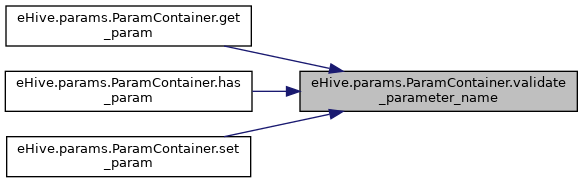
| def | validate_parameter_name (self, param_name) |
| Tells whether "param_name" is a non-empty string. More... | |
| def | debug_print (self, *args, **kwargs) |
| Print debug information if the debug flag is turned on (cf constructor) More... | |
| def | internal_get_param (self, param_name) |
| Equivalent of get_param() that assumes "param_name" is a valid parameter name and hence, doesn't have to raise ParamNameException. More... | |
| def | param_substitute (self, structure) |
| Take any structure and replace the pairs of hashes with the values of the parameters / expression they represent Compatible numbers, strings, lists, dictionaries (otherwise, ParamSubstitutionException is raised) More... | |
| def | subst_all_hashpairs (self, structure, callback) |
| Parse "structure" and replace all the pairs of hashes by the result of calling callback() on the pair content. More... | |
| def | subst_one_hashpair (self, inside_hashes, is_expr) |
| Run the parameter substitution for a single pair of hashes. More... | |
Public Attributes | |
| unsubstituted_param_hash | |
| param_hash | |
| debug | |
| substitution_in_progress | |
Detailed Description
Constructor & Destructor Documentation
◆ __init__()
| def eHive.params.ParamContainer.__init__ | ( | self, | |
| unsubstituted_params, | |||
debug = False |
|||
| ) |
Member Function Documentation
◆ debug_print()
| def eHive.params.ParamContainer.debug_print | ( | self, | |
| * | args, | ||
| ** | kwargs | ||
| ) |

◆ get_param()
| def eHive.params.ParamContainer.get_param | ( | self, | |
| param_name | |||
| ) |

◆ has_param()
| def eHive.params.ParamContainer.has_param | ( | self, | |
| param_name | |||
| ) |

◆ internal_get_param()
| def eHive.params.ParamContainer.internal_get_param | ( | self, | |
| param_name | |||
| ) |
Equivalent of get_param() that assumes "param_name" is a valid parameter name and hence, doesn't have to raise ParamNameException.
It is only used internally
Definition at line 113 of file params.py.
 Here is the call graph for this function:
 Here is the caller graph for this function:
◆ param_substitute()
| def eHive.params.ParamContainer.param_substitute | ( | self, | |
| structure | |||
| ) |
Take any structure and replace the pairs of hashes with the values of the parameters / expression they represent Compatible numbers, strings, lists, dictionaries (otherwise, ParamSubstitutionException is raised)
Definition at line 125 of file params.py.
Here is the call graph for this function: Here is the caller graph for this function:
◆ set_param()
| def eHive.params.ParamContainer.set_param | ( | self, | |
| param_name, | |||
| value | |||
| ) |

◆ subst_all_hashpairs()
| def eHive.params.ParamContainer.subst_all_hashpairs | ( | self, | |
| structure, | |||
| callback | |||
| ) |
Parse "structure" and replace all the pairs of hashes by the result of calling callback() on the pair content.
The result is a string (like structure)
Definition at line 168 of file params.py.
Here is the call graph for this function: Here is the caller graph for this function:
◆ subst_one_hashpair()
| def eHive.params.ParamContainer.subst_one_hashpair | ( | self, | |
| inside_hashes, | |||
| is_expr | |||
| ) |
Run the parameter substitution for a single pair of hashes.
Here, we only need to handle #expr()expr#, #func:params# and #param_name# as each condition has been parsed in the other methods
Definition at line 204 of file params.py.
Here is the call graph for this function: Here is the caller graph for this function:
◆ substitute_string()
| def eHive.params.ParamContainer.substitute_string | ( | self, | |
| string | |||
| ) |

◆ validate_parameter_name()
| def eHive.params.ParamContainer.validate_parameter_name | ( | self, | |
| param_name | |||
| ) |
Member Data Documentation
◆ debug
◆ param_hash
◆ substitution_in_progress
◆ unsubstituted_param_hash
The documentation for this class was generated from the following file:
- eHive/params.py