Bio::EnsEMBL::DBSQL::AnalysisAdaptor Class Reference
 Inheritance diagram for Bio::EnsEMBL::DBSQL::AnalysisAdaptor: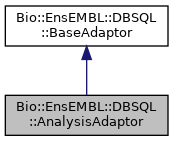
Detailed Description
Synopsis
-host => 'ensembldb.ensembl.org',
-user => 'anonymous'
);
$analysis_adaptor =
my $analysis = $analysis_adaptor->fetch_by_logic_name('genscan');
Description
  Module to encapsulate all db access for persistent class Analysis.
  There should be just one per application and database connection.
Definition at line 29 of file AnalysisAdaptor.pm.
Member Function Documentation
◆ _objFromHashref()
| protected Bio::EnsEMBL::Analysis Bio::EnsEMBL::DBSQL::AnalysisAdaptor::_objFromHashref | ( | ) |
◆ _store_description()
| protected Bio::EnsEMBL::DBSQL::AnalysisAdaptor::_store_description | ( | ) |
Undocumented method
Code:
click to view
◆ exists()
| public Int Bio::EnsEMBL::DBSQL::AnalysisAdaptor::exists | ( | ) |
  Arg [1]    : Bio::EnsEMBL::Analysis $anal
  Example    :
if($adaptor->exists($anal)) #do something
  Description: Tests whether this Analysis already exists in the database
               by checking first if the adaptor and dbID are set and
               secondly by whether it is in this adaptors internal cache.
               Note that this will not actually check the database and will
               not find and analysis which were recently added by other
               processes.  You are better off simply trying to store an
               analysis which will reliably ensure that it is not stored twice
               in the database.
  Returntype : int dbID if analysis is found, otherwise returns undef
  Exceptions : thrown if $anal arg is not an analysis object
  Caller     : store
  Status     : Stable
Code:
click to view
◆ fetch_all()
| public Listref Bio::EnsEMBL::DBSQL::AnalysisAdaptor::fetch_all | ( | ) |
  Args       : none
  Example    :
my @analysis = @{$analysis_adaptor->fetch_all()};
  Description: fetches all of the Analysis objects from the database and caches
               them internally.
  Returntype : listref of Bio::EnsEMBL::Analysis retrieved from the database
  Exceptions : none
  Caller     : AnalysisAdaptor::new
  Status     : Stable
Code:
click to view
◆ fetch_all_by_feature_class()
| public Listref Bio::EnsEMBL::DBSQL::AnalysisAdaptor::fetch_all_by_feature_class | ( | ) |
  Arg [1]    : string $feature_cless - The name of the feature class
  Example    :
my @analyses = @{$analysis_adaptor->fetch_all_by_feature_class('Gene');
  Description: Returns all analyses that correspond to a given
               feature class; see feature_classes method for a list.
  Returntype : Listref of Bio::EnsEMBL::Analysis
  Exceptions : none
  Caller     : general
  Status     : Stable
Code:
click to view
◆ fetch_by_dbID()
| public Bio::EnsEMBL::Analysis Bio::EnsEMBL::DBSQL::AnalysisAdaptor::fetch_by_dbID | ( | ) |
  Arg [1]    : int $internal_analysis_id - the database id of the analysis
               record to retrieve
  Example    :
my $analysis = $analysis_adaptor->fetch_by_dbID(1);
  Description: Retrieves an Analysis object from the database via its internal
               id.
  Returntype : Bio::EnsEMBL::Analysis
  Exceptions : none
  Caller     : general
  Status     : Stable
Code:
click to view
◆ fetch_by_logic_name()
| public Bio::EnsEMBL::Analysis Bio::EnsEMBL::DBSQL::AnalysisAdaptor::fetch_by_logic_name | ( | ) |
  Arg [1]    : string $logic_name the logic name of the analysis to retrieve
  Example    :
my $analysis = $a_adaptor->fetch_by_logic_name('Eponine');
  Description: Retrieves an analysis object from the database using its unique
               logic name.
  Returntype : Bio::EnsEMBL::Analysis
  Exceptions : none
  Caller     : general
  Status     : Stable
Code:
click to view
◆ new()
| public Bio::EnsEMBL::DBSQL::AnalysisAdaptor Bio::EnsEMBL::DBSQL::AnalysisAdaptor::new | ( | ) |
  Args       : Bio::EnsEMBL::DBSQL::DBAdaptor
  Example    :
my $aa = new Bio::EnsEMBL::DBSQL::AnalysisAdaptor();
  Description: Creates a new Bio::EnsEMBL::DBSQL::AnalysisAdaptor object and
               internally loads and caches all the Analysis objects from the
               database.
  Returntype : Bio::EnsEMBL::DBSQL::AnalysisAdaptor
  Exceptions : none
  Caller     : Bio::EnsEMBL::DBSQL::DBAdaptor
  Status     : Stable
Code:
click to view
◆ remove()
| public void Bio::EnsEMBL::DBSQL::AnalysisAdaptor::remove | ( | ) |
  Arg [1]    : Bio::EnsEMBL::Analysis $anal
  Example    :
$adaptor->remove($anal)
  Description: Removes this analysis from the database.  This is not really
               safe to execute in a multi process environment, so programs
               should not remove analysis while out on the farm.
  Returntype : none
  Exceptions : thrown if $anal arg is not an analysis object
  Caller     : ?
  Status     : Stable
Code:
click to view
◆ store()
| public Int Bio::EnsEMBL::DBSQL::AnalysisAdaptor::store | ( | ) |
  Arg [1]    : Bio:EnsEMBL::Analysis $analysis
  Example    :
$analysis_adaptor->store($analysis);
  Description: Stores $analysis in db.  If the analysis is already stored in
               the database its dbID and adaptor are updated, but the analysis
               is not stored a second time.
               Sets created date if not already set. Sets dbID and adaptor
               inside $analysis. Returns dbID.
  Returntype : int - dbID of stored analysis
  Exceptions : throw on incorrect argument
               throw if analysis argument does not have a logic name
  Caller     : general
  Status     : Stable
Code:
click to view
◆ update()
| public Int Bio::EnsEMBL::DBSQL::AnalysisAdaptor::update | ( | ) |
  Arg [1]    : Bio::EnsEMBL::Analysis $anal
  Example    :
$adaptor->update($anal)
  Description: Updates this analysis in the database
  Returntype : int 1 if update is performed, undef if it is not
  Exceptions : throw if arg is not an analysis object
  Caller     : ?
  Status     : Stable
Code:
click to view
The documentation for this class was generated from the following file:
- ensembl/modules/Bio/EnsEMBL/DBSQL/AnalysisAdaptor.pm